/master-professional-career-coach
/programs
/senior-professional-career-coach
/senior-professional-resilience-coach
/senior-professional-resume-writer
Speak with a Learning Advisor
Book a certification consultation with a learning advisor to help you find the perfect certification path

What Is Resilience Coaching? How It Works and Who It Helps.

Today's job market is anything but predictable. Employers are hesitant to hire. Employees are reluctant to leave. And experienced professionals who once felt secure in their careers are wondering what comes next.
You can do everything right and still get passed over for a promotion, lose a job you thought was secure, or watch a promising opportunity disappear. And just when you think you've figured things out, the rules change again.
Add AI, restructuring, and economic uncertainty, and it's enough to shake anyone's confidence.
Many are facing rejection, questioning their abilities, and worrying about their future. But resilience isn't something you either have or don't have. It's a set of skills you can build.
That's where resilience coaching comes in.
What is Resilience Coaching?
Resilience Coaching is about building career-related skills to handle setbacks, adapt to change, and make better decisions when things don't go as planned. Resilience coaching helps people manage their emotions, question assumptions, and trust their judgment even when the answers aren't clear. And learning how to build resilience at work can make a real difference, whether you're searching for your next job, trying to advance in your current role, or just trying to keep up with a workplace that won't stop evolving.
How Does Resilience Coaching Work?
A resilience coach isn't your personal cheerleader. A good coach helps you figure out what's getting in your way and what to do about it. That means recognizing negative thought patterns, challenging self-defeating beliefs, managing emotional reactions, and breaking habits that keep you stuck.
Say you've spent months applying for jobs. Nothing. You're frustrated, questioning your abilities, and wondering if anyone will ever hire you.
After enough rejection, it can be easy to start wondering if you're the problem. But is that really true? Maybe your job search strategy needs work. Maybe employers are looking for something different. Or maybe rejection has knocked your confidence so badly that it's showing up in interviews.
A coach helps you separate what's actually happening from the story you're telling yourself about it.
Here’s my favorite resilience coaching advice:
1. Give Yourself Grace. Everyone gets things wrong. You don’t have to keep paying for your mistakes. What matters is what happens next. A coach helps you notice your critical voice, process frustration, and learn from mistakes instead of letting them bring you down. Then you’re in a better position to move forward. Take Leo. A client I worked with who was a talented professional. And a perfectionist. He would replay even the smallestmistake over and over in his head, beating himself up until he was too stuck to move forward. Once he recognized how much the negative energy was holding him back, he was able to take a self-compassion check and practice a four-step self-compassion exercise: Observe, Contextualize, Normalize, Act. With practice, he learned to acknowledge a mistake, understand what went wrong, apply it moving forward, and let it go.
2. Catch Burnout Early. Burnout rarely shows up all at once. It starts with small signs, like work that used to matter but later loses meaning, or Sunday dread that won't go away. A coach helps you notice those signs, figure out what's draining you, and reconnect. Sometimes the fix is rest. Sometimes it's a new direction.
3. Stop People-Pleasing. Saying yes to everything feels helpful until you're overloaded, resentful, and behind on your own priorities. A coach helps you recognize when and why you agree to things you don't want to do, get clear on your values, and practice saying no without guilt. You can still be generous. You just get better at choosing where you spend your time.
4. Take Back Your Attention. Protecting your energy means knowing where to focus and when to stop. A coach can help you spot where you're wasting time, getting distracted, or taking on too much. That might mean using technology to cut busywork (or not letting your eyes glaze over using it), rethinking your priorities, or setting a firm quitting time and sticking to it.
5. Build Confidence from Evidence. Confidence doesn't come from positive thinking alone. It comes from proof. A coach helps you revisit challenges you've already overcome, identify what you did right, and use that evidence to tackle what's next. You've solved hard problems before. You can do it again.
The real work happens between sessions, when you put these skills to the test. With practice, you build the confidence to handle challenges on your own.
Who Can Benefit From Resilience Coaching?
You don't have to be in crisis to benefit from resilience coaching to make a difference. From job seekers to senior executives, it's especially useful for:
- Professionals Facing Layoffs or Career Setbacks. A prolonged job search can shake even the most experienced professional's confidence. Coaching helps you cope with rejection, recognize self-defeating assumptions, and regain momentum when the strategies that once worked aren't getting expected results.
- Professionals Navigating Change. AI, reorganizations, and shifting job expectations can leave capable employees questioning their abilities. Coaching helps them identify outdated ways of working, strengthen their capabilities, and adjust without viewing every workplace shake-up as a threat to their careers.
- Employees Experiencing Burnout. Dreading Monday before Sunday is over? Burnout can leave you exhausted, overwhelmed, and on edge. Burnout coaching often draws on the same resilience-building skills, helping you recognize warning signs, set boundaries, and focus on what you can control. The World Health Organization links burnout to chronic workplace stress. But coaching isn't mental health treatment, and it can't fix an unreasonable workload. Employers have work to do, too.
- Executives and Leaders Under Pressure. Restructuring, competing priorities, and high-stakes decisions can leave even experienced leaders second-guessing themselves. Coaching helps them stay composed, weigh options when information is incomplete, and guide their teams through uncertainty without letting stress call the shots.
- Organizations Investing in Employees. For HR and Learning and Development leaders, resilience training for professionals can be a valuable addition to employee development programs, especially during restructuring, rapid change, or periods of high stress. It can help employees manage pressure, recover from setbacks, and stay productive when uncertainty takes a toll. But coaching can't fix poor management, unrealistic workloads, or a workplace culture that's contributing to the problem.
Of course, resilience coaching isn't the answer to every professional, health, and wellness challenge. Sometimes you need support that’s more specific to your needs.
Resilience Coaching vs. Therapy vs. Career Coaching
Resilience coaching, therapy, and career coaching each serve a different purpose. It’s important to be familiar with how each area of expertise is different so you can seek the right kind of support you need.
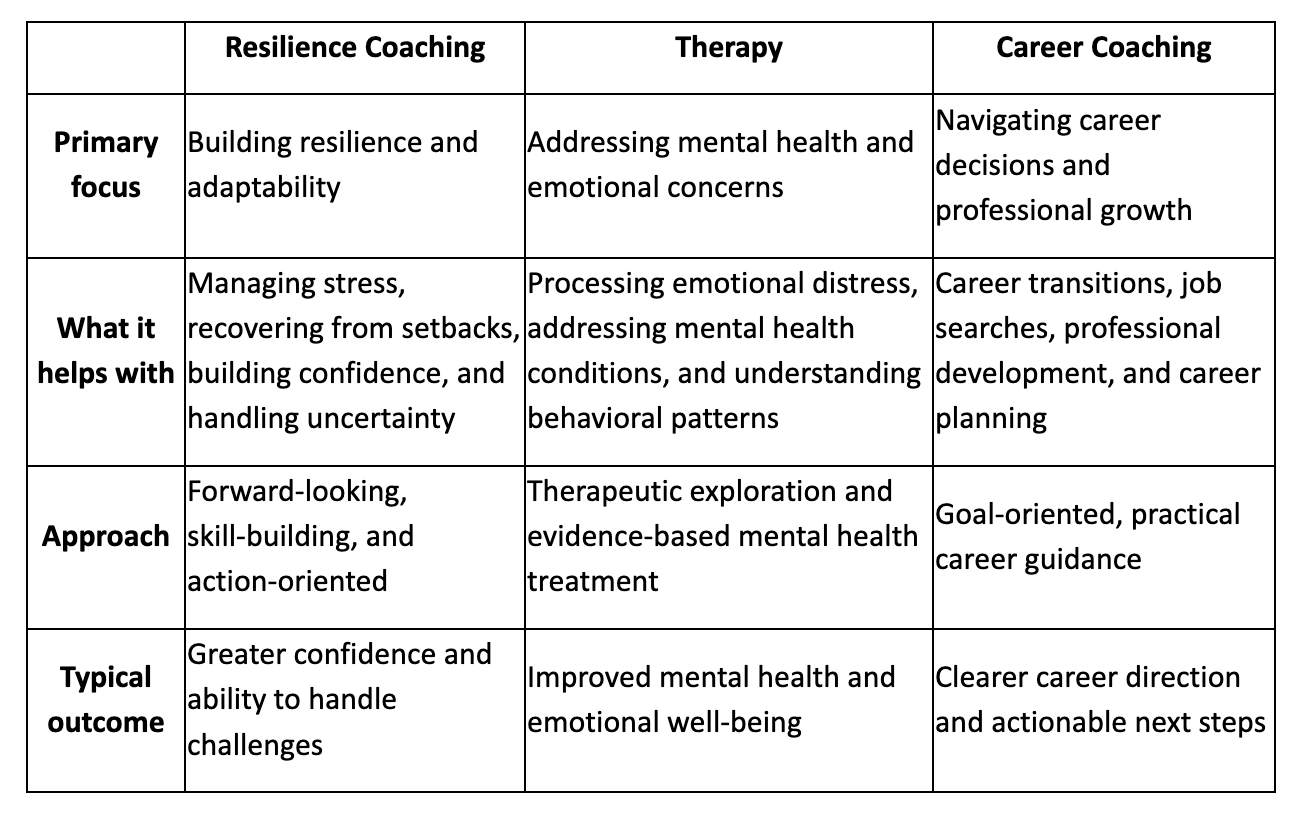
Consider someone who's just been laid off. They're upset. Questioning their abilities. Wondering what comes next.
A therapist might help them work through the emotional fallout. A resilience coach might help them stop second-guessing themselves, regain perspective, and deal with the uncertainty ahead. A career coach might help them identify opportunities and map out their next career move.
Different approaches. Different goals. And sometimes, you need more than one.
The right support depends on what you're struggling with. Sometimes you need a better career strategy. Sometimes you need help changing how you respond to setbacks. And sometimes you need professional mental health support. The important thing is recognizing what you need, rather than expecting one approach to solve everything.
What Results Can You Expect From Resilience Coaching?
Will resilience coaching ensure everything goes your way and make you stress-proof? Of course not. But it can change how you react to the tough stuff, whether that's a career setback, a difficult boss, an unexpected change, or a situation that leaves you questioning your abilities.
You may learn to bounce back without replaying every disappointment, keep your emotions from making decisions for you, and face the unknown with more confidence. Rather than dwelling on what went wrong, you can focus on what to do next. That’s meaningful.
There's research behind these approaches, too. A 2024 review published in Frontiers in Psychology examined workplace resilience coaching studies and found participants reported greater confidence in their ability to handle challenges, more hope, better recovery from stress, and changes in how they thought about difficult situations. A 2023 meta-analysis published in Academy of Management Learning & Education found significant improvements across stress management, burnout, skill building, achieving goals, and improving leadership behaviors.
Sometimes, building resilience means taking a hard look at yourself. That's what happened to Ben, a top project manager who turned to career coaching to become a more effective leader. He hit his deadlines, stayed under budget, and took pride in being straightforward. But when it came to toxic behavior at work, he was quick to point out the flaws in difficult colleagues. He never considered his own.
To take a closer look at his own behavior, Ben took a challenging self-assessment. He also asked a mentor and colleague for honest feedback. Both confirmed his blind spot: he downplayed problems by pointing to others' mistakes and regularly interrupted colleagues. The very behavior he couldn't stand in others.
The results were hard for Ben to swallow. But instead of getting defensive, he immediately put his new insights to work. Instead of talking over people and being reactive, he started pausing and counting to three before responding and became a better listener. He also began treating feedback as collaboration, not finding fault.
His new approach made him a more approachable leader, helped him build stronger relationships with colleagues, and gain a better understanding of the people he used to write off.
Resilience coaching helps you recognize what's holding you back, sharpen your EQ, and improve your behaviors for better outcomes so you've got a better shot at reaching your goals.
How Do You Become a Certified Resilience Coach?
If you're already helping individuals or teams navigate career challenges, why not add resilience coaching to your toolkit? It's a natural next step, especially when so many professionals are struggling with stress, uncertainty, and change.
The International Association of Career Coaches (IACC) has a six-week Senior Professional Resilience Coach (SPRC)™ Certification program designed for career coaches, experienced coaches, and HR professionals ready to expand what they can offer clients. You'll learn how to help people manage stress, challenge limiting beliefs, clarify what matters most, and find their footing when things don't go as planned.
I particularly enjoy hearing the great feedback about how the curriculum starts with the coach. You. Before helping clients work through difficult situations, you need to recognize how you respond to uncertainty, stress, and disappointment. From there, the curriculum explores how to build the trust and psychological safety that allow clients to open up and do the work.
From grounding techniques and emotional regulation to practical coaching exercises, the program gives you tools you can put to work with clients.
Ready to add resilience coaching to your skill set? Explore IACC's Senior Professional Resilience Coach (SPRC)™ Certification and see where it could take your coaching practice.