/master-professional-career-coach
/programs
/senior-professional-career-coach
/senior-professional-resilience-coach
/senior-professional-resume-writer
Speak with a Learning Advisor
Book a certification consultation with a learning advisor to help you find the perfect certification path
How to Become a Career Coach

How to Become a Career Coach
Choosing a career path isn't a one-time decision, and a paycheck alone isn't always enough to keep people fulfilled. Today, professionals change jobs more frequently, switch industries, and face layoffs, economic uncertainty, and the growing impact of AI. At the same time, they're becoming more intentional about the kind of work they do and how it aligns with their values and supports their chosen lifestyle.
The trends are hard to ignore. Recent research from organizations including the World Economic Forum, Gallup, and LinkedIn suggests these workforce changes are likely to continue.
With so much at stake, it's no surprise that more people are turning to career coaches for guidance. A skilled coach can help clients gain perspective, evaluate their options, prepare for new opportunities, and move toward their goals with greater confidence. AI has become a valuable resource for job seekers, but it can't replace the judgment and personalized experience that help people make complex career decisions.
If you're the person friends, coworkers, or family naturally turn to for advice about work, you may have wondered whether becoming a career coach is the right path for you. I put this guide together to encourage people who are curious about career coaching to take a closer look at the profession. There's much more to being a great career coach than giving good advice.
I'll walk you through what career coaches do, the skills and qualifications that matter most to gaining credibility, the value of certification, and seven practical steps to get started. If you've been thinking about transitioning into career coaching, it's important to understand the skills, commitment, and preparation required to build a successful practice.
What Does a Career Coach Do?
A career coach enables people to make informed decisions about their professional future. That might mean helping someone identify a new career direction, navigate a layoff, prepare for interviews, pursue a promotion, negotiate an offer, or recognize opportunities they may not have considered on their own.
Career coaching is much more than giving advice or rewriting résumés. It's a structured process that combines coaching techniques with career expertise to advise people to move toward their goals more strategically. A great coach brings an outside perspective, shares proven strategies, asks thought-provoking questions, and shows clients how to create realistic action plans they can put into practice. That often means reaching goals more efficiently, avoiding costly detours, and gaining a competitive edge in today's job market.
A typical coaching engagement includes one-on-one coaching sessions, personalized feedback, assessments, and practice exercises between meetings that keep them advancing toward their goals. Those might include researching career options, expanding their network, practicing interview responses, updating a résumé or LinkedIn profile, or completing action steps tied to their coaching plan.
While landing a new job is often the immediate objective, career coaching is ultimately about enabling people to manage change more effectively and build fulfilling careers over the long term.
Career Coach vs. Career Counselor vs. Résumé Writer vs. Recruiter
As you think about the role of a career coach, it's important to understand how career coaching differs from other career-focused professions. The roles often overlap, which is why they're easy to confuse. While some professionals offer more than one of the services below, each has a different primary focus.
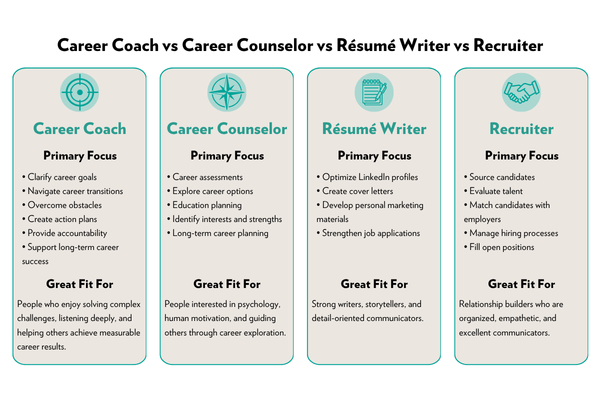
Career coaching takes the broadest view. Rather than focusing on one part of a client's job search, coaches teach people actionable information and introduce them to strategies and new perspectives, equipping them to make better career choices throughout their working lives.
Who Can Become a Career Coach?
One of the things I love about career coaching is that you don’t need a background in HR or a career-related field. . I've worked with aspiring coaches from a wide range of fields and backgrounds. What they all shared wasn't a specific job title or degree. It was a genuine interest in empowering others, strong communication skills, curiosity, empathy, and a willingness to learn how to coach effectively.
Great coaches know how to listen, ask meaningful questions, build trust, and guide others toward taking accountability for their careers. If you're worried you don't have the "right" background, you're not alone, and you may find the International Association of Career Coaches’ (IACC) guide, “How to Become a Career Coach With No Experience,” helpful.
Your own career journey can also become one of your greatest strengths. Many successful coaches have experienced career challenges themselves, whether that's navigating a layoff, changing industries, negotiating a salary, returning to work after time away, or feeling stuck. Shared experiences can help you relate to clients, build trust, and better understand the emotions that often come with a career change and its inherent risks.
I always want to remind aspiring coaches that even though their experience is valuable, it isn't enough on its own. Knowing what worked for you is different from knowing how to coach someone else through their own situation. That's where professional training and a structured coaching approach make all the difference. It gives you the skills and framework to guide each client based on what's right for them, not just what worked for you.
What Skills Do Career Coaches Need?
The best career coaches combine strong coaching skills with career development expertise and relevant knowledge of the job market. No one starts out mastering all of these skills. They develop over time through training, experience, and working with clients.
I've found that most clients already have some idea of what they want to do. What they're often missing is the critical thinking, strategy, or accountability to take the next step. That's why the following skills are so important.
- Active Listening: Career coaching starts with listening, not talking. Great coaches pay attention not only to what clients say, but also to what's holding them back, where they lack confidence, and the opportunities they may not see for themselves.
- Emotional Intelligence: Career change can be emotional. Clients often come to coaching feeling uncertain, discouraged, overwhelmed, or fearful about what's next. Emotional intelligence equips coaches to create a supportive environment while still challenging them to grow.
- Powerful Questioning: Rather than giving quick answers, effective career coaches ask targeted questions that challenge clients to uncover new perspectives, challenge assumptions, and arrive at their own decisions.
- Critical Thinking: Great coaches don't simply follow a formula. They analyze situations, identify patterns, weigh options, and partner with clients to think through complex issues.
- Goal Setting and Accountability: Insight alone isn't enough. Coaches teach their clients how to create and follow realistic action plans, break them into manageable steps, and stay accountable along the way.
- Career Development Knowledge: Understanding workplace trends, organizational dynamics, and how careers evolve allows coaches to provide informed guidance.
- Job Search Strategy: Coaches should understand personal branding, networking, salary negotiation, applicant tracking systems, and current hiring practices so they can competitively position clients more effectively.
- Résumé, LinkedIn, and Interview Awareness: While career coaching goes far beyond résumé writing, coaches should understand what makes a strong résumé, an effective LinkedIn profile, and successful interview preparation.
- Ethics and Integrity: Career coaches are trusted with deeply personal conversations. They protect confidentiality, maintain healthy boundaries, recognize the limits of their expertise, and always act in their clients' best interests.
- Business and Marketing Skills: If you plan to work independently, you'll also need to know how to market your services, attract clients, price your offerings, and run a business.
Don't worry if you don't have every one of these skills today. Most successful career coaches build them over time through professional training, practice, mentoring, and experience. Your goal is to continue to learn so you can better serve your clients throughout your career.
Do You Need a Degree to Become a Career Coach?
The short answer is no. There are no degree requirements to become a career coach, and successful coaches come from many different educational and professional backgrounds.
Degrees in human resources, psychology, education, leadership, recruiting, counseling, communications, or business can certainly be useful. They provide knowledge and transferable skills that can support your work. But a degree alone doesn't make someone an effective career coach.
What clients are really looking for is someone they trust. They want a coach who knows how to ask thoughtful questions, guide meaningful conversations, follow a structured coaching process, counsel them to think through complex decisions, and achieve meaningful results.
That's why many aspiring career coaches invest in professional training and certification. Training provides the skills, frameworks, and critical industry knowledge to coach effectively, while certification can strengthen your credibility. Together, they give you a strong foundation for building a successful coaching practice, no matter where you started professionally or academically.
Do You Need a Career Coach Certification?
Not necessarily. In many places, you don't need a career coaching certification to begin working as a career coach.
The value a certification can give you, especially when you're just getting started, is to help you build the skills, structure, and credibility needed to work with paying clients. Instead of you trying to figure everything out through trial and error, a certification provides a proven coaching framework that gives you an effective coaching process. You can then confidently use what you have learned from one client to the next to build and grow your practice and establish your professional reputation.
A quality career coaching certification can help you:
- Develop strong coaching skills
- Learn a repeatable coaching process
- Feel better prepared to work with paying clients
- Establish professional credibility
- Differentiate yourself in a competitive market
- Feel more prepared to launch and grow your coaching practice
Whether you're comparing certification programs or still deciding whether career coaching is the right next step for you, IACC's Senior Professional Career Coach (SPCC) certification is designed to prepare aspiring coaches for real-world practice. Through hands-on training, proven coaching frameworks, practical tools, and a global community of career coaches, the program provides the skills, structure, and professional foundation to launch and grow a successful coaching practice.
Now that you have a better understanding of the profession, let's walk through a simple seven-step roadmap to build the skills, experience, and credibility needed to establish yourself as a professional career coach.
Step 1: Explore the Career Coaching Profession
Career coaching is a profession built on conversations, curiosity, problem-solving, and supporting people through some of the most important decisions of their professional lives. Every client brings a different story. One person may be recovering from a layoff, while another is preparing for a promotion, changing industries, or trying to figure out what they want to do next. You might hear clients say things like:
- "I don't know what I want to do next"
- "I need help finding a better job"
- "I was laid off and don't know where to start"
- "I want to change industries"
- "I need help preparing for interviews"
- "I want to move into a leadership role"
- "I need someone to help keep me accountable"
What I enjoy most about career coaching is that no two clients are exactly alike. Every conversation is different, every challenge is unique, and every success looks a little different. Helping someone gain perspective, discover possibilities they hadn't considered, and take meaningful steps toward a better future is incredibly rewarding.
Career coaching also offers the flexibility to shape a career around your own interests and strengths. Some coaches build independent practices, while others work within organizations, universities, workforce development programs, or consulting firms. Your income will depend on factors such as your niche, pricing, experience, marketing, and whether you coach part-time or full-time. Like any profession, building a successful practice takes time, but for many coaches, it's both personally rewarding and financially worthwhile.
Step 2: Choose a Career Coaching Training Program
Not all career coach training programs are created equal. As you compare your options, look beyond the marketing and ask yourself what you'll actually be able to do when you finish.
A strong training program should give you the knowledge, skills, and readiness to work with real clients. Look for one that includes:
- A career-specific curriculum that specializes in career coaching rather than general life coaching, which includes career coaching as one topic within a broader curriculum. Avoid programs that emphasize coaching life, relationships, or other modalities that don’t relate directly to careers.
Look for training with a focus on:
- Practical career coaching skills such as résumé strategy, LinkedIn optimization, interview preparation, job search strategy, and career development
- Today's hiring practices and labor market trends
- Client-ready tools and resources
- Proven career coaching frameworks you can use to confidently guide client conversations
- Ethical guidelines that help you coach with professionalism and integrity
- Opportunities to practice with real-time feedback from experienced instructors
- Business-building guidance if you plan to start your own coaching practice
- Industry credibility or accreditation that strengthens your professional reputation
- An active community and ongoing support so you're not building your business alone
I strongly suggest that when evaluating any training program, you ask yourself, “Will the program prepare me to confidently coach my first paying client?” If the answer isn't a clear yes, keep looking.
The IACC's Senior Professional Career Coach (SPCC) certification is designed with that goal in mind by providing actionable coaching skills and career development expertise to prepare aspiring career coaches to launch their coaching practice with a strong foundation.
Step 3: Practice Your Coaching Skills
No one becomes a good or great career coach just by reading books or completing online training. Coaching is a skill you develop through practice, reflection, and feedback.
Every coaching conversation teaches you something. The more experience you gain, the more comfortable you'll become asking thoughtful questions, navigating different situations, and trusting the coaching process. Like any skill, capability comes from doing the work, not just learning about it.
As you're building your experience, look for opportunities to:
- Practice with classmates or peer coaches
- Work with practice clients
- Learn from case studies and real-world coaching examples
- Reflect after each coaching session on what went well and what you'd do differently next time
- Seek feedback from instructors, mentors, or experienced coaches
One of the biggest advantages of a quality training program is that you can build your skills in a supportive environment before coaching paying clients on your own. The more opportunities you have to practice and receive feedback, the more prepared you'll feel when it's time to launch your coaching practice.
Step 4: Decide What Type of Career Coach You Want to Be
A common mistake I see new coaches make is trying to coach everyone. I get that it feels logical at first, thinking that the more people you can help, the more potential clients you'll have. But in reality, broad positioning often makes it harder for potential clients to recognize that you're the right coach for them.
Your niche doesn't have to limit your future opportunities. It just gives you a clear starting point to better communicate your expertise more clearly and attract the clients you are best suited to serve and enjoy working with the most.
For example, you might become a:
- Career Transition Coach
- Executive Career Coach
- New Graduate Career Coach
- Leadership Career Coach
- Return-to-Work Coach
- Résumé and LinkedIn Coach
- Career Confidence or Resilience Coach
Once you know what type of career coach you want to become, read IACC’s guide, “How to Start a Career Coaching Business in 2026,” for actionable advice on turning it into a successful coaching practice.
Step 5: Build Your First Coaching Package
The next step is turning your services into a coaching package. To avoid a mistake I see many new career coaches make, I suggest you start with one simple coaching service package that solves one specific problem for one type of client.
Clients aren’t looking to buy an hour of coaching. This is why you want to package your services around a specific need. This will better communicate what they'll receive, the value of what you're offering, and what results they're working toward.
A typical example is a Job Search Strategy Package that’s 4-6 sessions focused on job search planning, networking strategies, personal branding, and job search execution.
You can always expand your services as your experience grows. Starting with one clear offer makes it easier to explain what you do, attract the right clients, and build competence as a new coach. And you don’t need to wait for your website to be done to get started.
Find more package examples and learn more about choosing your niche, defining the problems you solve for clients, and selling your services in IACC’s guide, “How to Start a Career Coaching Business in 2026.”
Step 6: Start Building Trust and Credibility
People won't hire you just because you call yourself a career coach. They'll hire you because they believe you can help them. Building that trust means consistently demonstrating your knowledge, professionalism, coaching capabilities, and commitment to achieving meaningful results.
Some of the best ways to build trust include:
- Earning a respected career coaching certification to demonstrate your commitment and expertise
- Optimizing your LinkedIn profile and maintaining a professional presence so prospective clients can easily learn more about you
- Sharing relevant career advice through articles, videos, or social media to showcase your knowledge and build visibility
- Hosting workshops or presentations for job seekers or organizations to demonstrate your expertise and connect with potential clients
- Collecting and sharing testimonials as you gain experience to provide social proof
- Creating case studies that highlight your successful client outcomes
- Joining a professional career coach directory to increase your visibility
- Growing your referral network through clients and professional connections to create a steady source of future opportunities
Remember, credibility isn't built overnight. It's earned one conversation, one client, and one success story at a time. Stay committed to learning, keep showing up for your clients, and let your results speak for themselves. Your reputation will grow alongside your coaching practice.
Step 7: Get Your First Clients
The most frequent question I get asked by aspiring career coaches is, "How do I get my first clients?" My answer is simpler than you might think, and it starts with assuring you that you don’t need a large social media following, a website, or a big marketing budget to get started. Just get started.
Many successful career coaches find their first clients by letting their personal and professional networks know what they do. Others build visibility by sharing meaningful content on LinkedIn, hosting workshops, participating in professional communities, and asking satisfied clients for referrals.
Networking and building relationships with professionals who serve similar audiences, such as HR professionals, recruiters, résumé writers, alumni associations, and outplacement firms will always be time well spent. Those partnerships can become a valuable source of referrals over time.
What matters most is to stay visible, build relationships, and consistently demonstrate your expertise. Client acquisition doesn't happen overnight, but every conversation, referral, workshop, and piece of content builds momentum.
Dive deeper into pricing, marketing, finding clients, and building a sustainable coaching practice, in IACC’s guide, "How to Start a Career Coaching Business in 2026."
How Long Does It Take to Become a Career Coach?
There's no one-size-fits-all timeline for becoming a career coach. How quickly you get started depends on your background, the training you choose, how much time you can dedicate to learning, the niche you pursue, and whether you're building a side business or a full-time coaching practice.
You can begin learning the fundamentals of career coaching relatively quickly. But becoming a confident, credible coach takes more than completing a training program. It comes from applying what you've learned, working with real clients, and gaining experience over time.
Early on, you'll be focused on remembering frameworks and wondering whether you're asking the best questions. As you gain experience, your attention shifts almost entirely to the person sitting in front of you. That's when coaching starts to feel less like following a process and more like having meaningful conversations that truly connect with people. Everyone reaches that point on their own timeline.
Final Thoughts: Becoming a Career Coach
If this guide has confirmed that career coaching feels like the right fit for you, the next step is preparing yourself to do it well. As you've seen, becoming a successful career coach involves much more than enjoying career conversations or giving good advice. It requires coaching skills, a structured process, hands-on experience, and genuinely wanting people to make the best career decisions possible with your guidance.
After training hundreds of aspiring career coaches, I've found that what separates good coaches from exceptional ones usually isn't passion. It's their drive to continually improve their coaching skills and serve their clients well.
If you're ready to become a career coach with the training, structure, and credibility clients are looking for, I invite you to explore IACC’s Senior Professional Career Coach (SPCC) certification. It's designed to help you build the skills, coaching framework, and professional foundation to confidently support clients throughout their careers.
Frequently Asked Questions
Q: What does a career coach do?
A: A career coach helps people navigate career challenges, make informed decisions, and achieve their professional goals. Depending on a client's needs, that may include clarifying career direction, developing a job search strategy, preparing for interviews, changing industries, negotiating offers, or creating an action plan to reach long-term career goals.
Q: What skills does a career coach need?
A: Successful career coaches combine strong coaching skills with career development expertise and practical job market knowledge. They know how to listen actively, ask thoughtful questions, create action plans, provide accountability, understand hiring trends, and guide clients through important career choices with professionalism and integrity.
Q: How do I become a career coach?
A: Start by learning what career coaching involves and deciding whether it's the right fit for you. From there, complete a career coach training or certification program, practice your coaching skills, choose a niche, build credibility, and begin working with clients. As you gain experience, you'll continue refining your coaching approach and growing your practice.
Q: How long does it take to become a career coach?
A: There's no single timeline. How quickly you become a career coach depends on your background, the training you choose, how much time you dedicate to learning, your niche, and your business goals. You can begin learning the fundamentals quickly, but becoming a skilled, credible coach takes practice, experience, and ongoing professional development.
Q: Is career coaching a good career?
A: Career coaching can be an incredibly rewarding profession for people who enjoy helping others solve problems, navigate change, and achieve meaningful professional goals. Many coaches build successful full-time or part-time practices, while others work within organizations, universities, workforce development programs, or consulting firms. Like any profession, success depends on your training, experience, niche, and ability to attract and serve clients.
Q: Can I become a career coach without an HR background?
A: Absolutely. Career coaches come from many different professions, including recruiting, education, leadership, consulting, business, and communications. While HR experience can be valuable, what matters most is your ability to coach effectively, build trust, and help clients navigate important career decisions.
Q: Do I need a degree to become a career coach?
A: No. There isn't a single degree required to become a career coach, and successful coaches come from many different educational and professional backgrounds. While degrees in areas such as HR, psychology, education, counseling, communications, or business can be helpful, clients are ultimately looking for someone with the skills, knowledge, and credibility to help them achieve meaningful results.
Q: Do I need a certification to become a career coach?
A: Not necessarily. In many places, certification isn't legally required, but it can provide a significant advantage. A quality certification program helps you develop coaching skills, learn a repeatable coaching process, build credibility, and feel better prepared to work with paying clients.
Q: How do I choose the right career coach training program?
A: Look for a program that teaches career-specific coaching skills rather than general life coaching. A quality program should include proven coaching frameworks, effective tools, opportunities to practice with feedback, ethical guidelines, business-building guidance, and ongoing support so you feel prepared to work with paying clients.
Q: What career coaching niche should I choose?
A: The best career coaching niche is one that aligns with your experience, interests, and the type of clients you most enjoy helping. Some career coaches specialize in executive coaching, leadership development, career transitions, job search strategy, interview preparation, salary negotiation, or early career professionals. Others focus on specific industries such as technology, healthcare, finance, education, or government. As you gain experience, you may refine your niche even further, allowing you to better position your services and attract your ideal clients.
Q: What is the difference between a career coach and a career counselor?
A: While the roles can overlap, career coaches typically help clients clarify goals, navigate career transitions, develop job search strategies, and create action plans. Career counselors often have formal counseling or educational backgrounds and may focus more on assessments, career exploration, education planning, and long-term career development. Some professionals offer both services, but the roles are not identical.